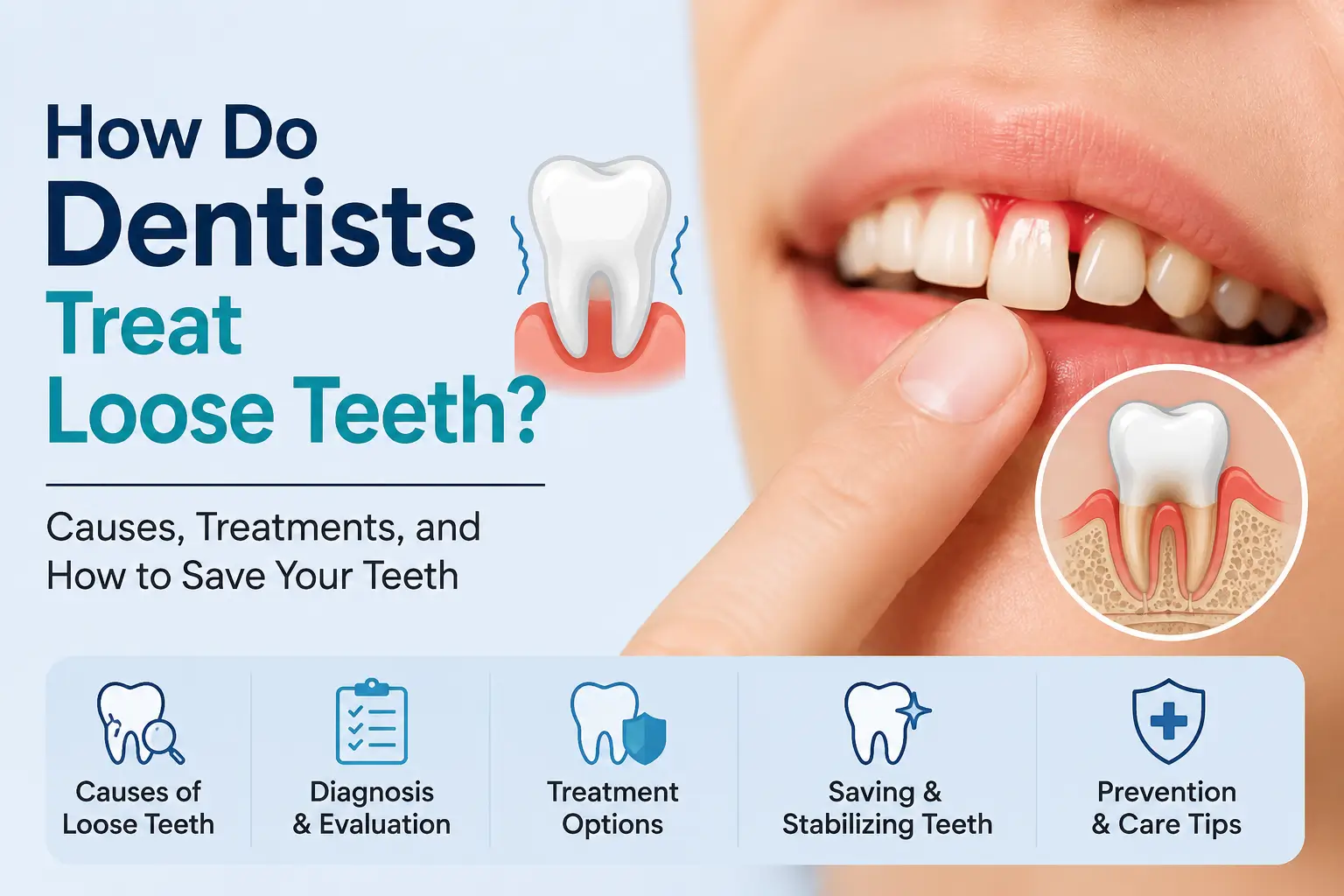
A loose tooth in adults can feel frightening, especially when permanent teeth are supposed to stay firmly in place. While loose teeth often indicate underlying gum disease, injury, or bone loss, many cases can still be treated successfully if caught early. In this guide, we’ll explain what causes loose teeth, how dentists diagnose the problem, and the treatments that may help save your tooth.
Adult healthy teeth have their roots embedded in the jawbone and gum tissue, forming an strong support structure for the teeth. If something happens to weaken this structure, the teeth may start wobbling, a condition dentists call tooth mobility or loose teeth.
The following symptoms are characteristic of loose teeth:
It is always worrisome because adults' teeth are not supposed to move. Pain might not occur immediately, hence the reason most individuals ignore it. Gum inflammation is one of the most common early warning signs associated with loose teeth. However, other causes include clenching or trauma.
According to the American Academy of Periodontology, gum disease is the leading cause of tooth loss among American adults.
If there is enough healthy bone and gum support left, then the condition can still be stabilized if detected earlier.
There is an assumption that people have loose teeth because of ineffective brushing. Loosening of teeth occurs when the bones, ligaments, and gums that support the teeth begin to deteriorate. Periodontal disease is the primary cause of loose teeth. It occurs due to the formation of plaque close to the gum line. Periodontal disease leads to bone loss, weakening tooth support. Nearly half of all adult Americans over 30 suffer from periodontal disease, according to the Centers for Disease Control and Prevention.
Other typical causes include:
A loose tooth rarely happens suddenly. In most cases, there will be warning signs from your mouth that you may not notice until you begin to see more visible changes.
Warning signs to look out for include:
One of the earliest symptoms of gum disease is bleeding gums. With this condition, the gums may swell, become tender, and become irritated.
The condition may advance to the point where the gums begin to recede from the teeth. It is important to identify this problem early because the earlier the condition is diagnosed, the less likely the tooth will become loose.
Loose teeth mean very different things at different ages. In children, it is completely normal and part of growth. Loosening of baby teeth occurs as permanent teeth push them out from beneath, leaving room for adult teeth to emerge correctly.
For adults, it acts as an alarm bell. Permanent teeth should be fixed in their places permanently, and any loosening indicates a dental issue.
Key differences:
Emotions are also crucial here. As an example, a child will get excited about their wobbly tooth, while an adult will be frightened or even embarrassed.
Knowledge of this difference will definitely help identify the right option.
Yes, a professional dentist in Queens can fix the loose teeth through professional procedures. Dentists first determine the reasons behind the looseness. Trauma-related loosening is treated much differently from gingival disease-related loosening. There are some situations in which teeth can be cleaned or the bite adjusted. Others need advanced periodontal care to rebuild lost support.
The very first and most crucial concern that arises in people's minds when they realize their tooth has become loose is how to save it. In general, the response to this dilemma is positive. Dentists regularly treat loose teeth and can often stabilize them successfully. The faster one seeks treatment, the better it is for patients.
Mobility level also matters. Mild movement usually responds more favorably than excessive looseness. With sufficient normal bone, dentists frequently can arrest or at least significantly reduce loosening over time.
As explained by the National Institute of Dental and Craniofacial Research (NIDCR), untreated periodontal disease can lead to destruction of the supporting gum tissue and bone.
It’s always the dentist’s preference to preserve natural teeth when possible since they outperform artificial substitutes. Combining early intervention with good oral hygiene practice can provide excellent results.
The simple truth is that a loose tooth does not equate to an extraction, but it all comes down to timing.
A loose tooth exam involves more than checking movement. Dentists must first identify the cause of the problem before deciding on a treatment method.
In most cases, this requires an examination in which the dentist assesses the degree of movement and swelling of the tooth relative to others.
The following is the classification of tooth mobility:
X-rays are essential because they reveal hidden bone loss and root issues not visible during an exam. They help evaluate:
If gum disease is suspected, gum pocket measurements may also be taken. Deeper pockets often indicate a more advanced infection.
This diagnosis step is important because it defines whether the tooth can be stabilized or if advanced treatment is required. Even when findings sound serious, diagnosis is actually the first step toward saving the tooth.
Indeed, sometimes, but only in certain circumstances. If a tooth is slightly mobile due to a mild inflammatory process or trauma, its stability can be achieved after the irritant is removed. A loose tooth resulting from grinding teeth can be stabilized with a night guard to reduce pressure on the tooth.
In general, though, moderate to severe loosening does not usually heal on its own.
Bone loss from advanced gum disease usually does not recover naturally without professional treatment, though regenerative dental procedures may help restore some lost support. Waiting often allows the condition to progress silently, even without pain.
Many people delay care because the tooth still feels “mostly fine.” But the lack of pain does not mean there is no damage.
A loose tooth becomes more urgent when you notice:
Some cases improve significantly after professional treatment removes infection and inflammation. Gums can stabilize and feel firmer again when healing begins properly. A simple rule applies: never assume it will fix itself without a dentist’s evaluation.
Although loose teeth can be frightening, there are steps you can take to lessen the issue. The irritation will only get worse if you touch or poke at your teeth.
Begin with simple prevention methods:
Do not snap the floss in between your gums or floss aggressively. Rinse your gums with salt water to reduce swelling. A saltwater rinse is effective for reducing swollen gums, but it cannot stabilize your teeth.
Delaying treatment of a displaced tooth is among the biggest mistakes that one could ever make.
Treatment depends heavily on the cause of the looseness. Initially, patients can undergo scaling and root planning to remove plaque and bacteria below the gum line.
If teeth grinding causes tooth loosening, patients are advised to wear mouth guards to reduce the pressure on their teeth while sleeping.
Loose teeth can also be treated with splinting, in which the loose tooth is bonded to other teeth to keep it stable.
When the cause of tooth loosening is biting pressure, small corrections are made in order to equally distribute the pressure among other options of treatment, including:
Modern dentistry presents various options for saving a loose tooth before it is too late.
Gum disease develops slowly but can eventually cause substantial harm. First, plaque forms, which then causes inflammation below the gums. Eventually, it begins destroying bone support.
Dentists first focus on stopping infection. Without controlling bacteria, healing cannot begin.
Common treatments include:
All wounds heal with time, but they need upkeep. Without it, gum disease can recur. Early treatment can lead to positive effects such as stabilization, healthy gums, and reduced bleeding.
A loose front tooth is especially stressful because it affects appearance and confidence. First, avoid putting pressure on it. Do not bite with front teeth. Cut food into small pieces and chew using back teeth.
Next, schedule a dental visit quickly. In most cases, the front teeth react positively to early treatment, owing to their solid foundation.
These treatments can range from bite correction to splinting to even gingival treatments, depending on the underlying causes.
Early treatment is highly effective in most cases; however, delaying treatment poses certain risks. Front teeth are significant for both oral functionality and aesthetics; thus, early treatment is indicated.
Saving a loose tooth depends heavily on the speed of treatment. Early intervention gives the best chance of success.
Dentists focus on:
Emergency splinting may be used to stabilize the tooth during recovery.
At home, you can only support the tooth, not fix it:
There is no home remedy that can tighten a loose tooth. Professional care is always required for long-term stability.
Home care cannot fix a loose tooth, but it can reduce irritation before treatment.
Helpful steps include:
What home care cannot do:
These steps only support comfort until dental treatment begins.
Most loose teeth develop gradually, making prevention important.
Some helpful tips are:
Your diet affects gum and bone health more than you might think.
Nutrients include:
Also avoid:
These changes help reduce plaque buildup and lower the risk of gum disease.
Dental problems often develop silently. You may not feel pain until damage is advanced.
During checkups, dentists can:
Professional teeth cleaning removes hardened plaque that is difficult to remove through regular brushing.
Most people need appointments twice a year, though some may need more based on their risk factors.
Certain conditions require emergency attention:
Loosened teeth due to an injury require immediate attention as an emergency case.
The duration of healing depends on the cause of the condition. Inflammation can resolve after several weeks of dental procedures. Cases involving trauma can heal at a slower rate, particularly those requiring stabilization.
Severe periodontitis requires prolonged treatment and heals gradually rather than immediately. Early intervention ensures successful healing.
A tooth may not be savable when:
In such cases, extraction may be recommended. Replacement options such as implants or bridges effectively restore function and appearance.
A loose tooth in adults is an indication, but certainly not the end result. Treatment is still possible with many cases, even when detected at a relatively late stage. There are several options available for dental specialists to keep the tooth in place, cure an infection, and heal the gums. Timing becomes the key element. Quick action may make all the difference.
Yes, gum disease is one of the most common causes of loose teeth in adults. As gum disease progresses, bacteria and inflammation begin damaging the gums, ligaments, and jawbone that support the teeth. Over time, this loss of support can cause teeth to loosen or shift. Early treatment can often stop the progression and help stabilize the tooth.
Healing time depends on the cause and severity of the loose tooth. Mild cases caused by inflammation or minor trauma may improve within a few weeks after treatment. More advanced cases involving gum disease or bone loss may require several months of professional care and monitoring. Early treatment usually leads to faster and better recovery.
Yes, a general dentist can diagnose and treat many cases of loose teeth. Treatment may include deep cleaning, bite adjustment, splinting, or infection control. If the condition is severe, the dentist may refer you to a periodontist, a specialist who treats advanced gum and bone problems.
The cost depends on the cause of the problem and the treatment needed. Simple treatments like deep cleaning or a night guard may cost less, while procedures such as gum surgery, splinting, or bone grafting can be more expensive. Dental insurance may cover part of the treatment if it is medically necessary.
In some cases, yes. A mildly loose tooth caused by inflammation, teeth grinding, or minor injury may become firmer after the underlying issue is treated. However, teeth loosened by advanced gum disease or severe bone loss usually require professional dental treatment to stabilize them.
No, a loose adult tooth cannot usually tighten naturally without professional treatment. Home remedies may help reduce irritation or swelling, but they cannot rebuild bone or repair damaged support structures. Seeing a dentist early gives the best chance of saving and stabilizing the tooth.
YOUR FIRST STEP TOWARDS A BEAUTIFUL SMILE IS JUST A PHONE CALL AWAY!